¡Voices of a People's History!


Here's another event I will be in. It's this Sunday...

Voices Breaking Boundaries
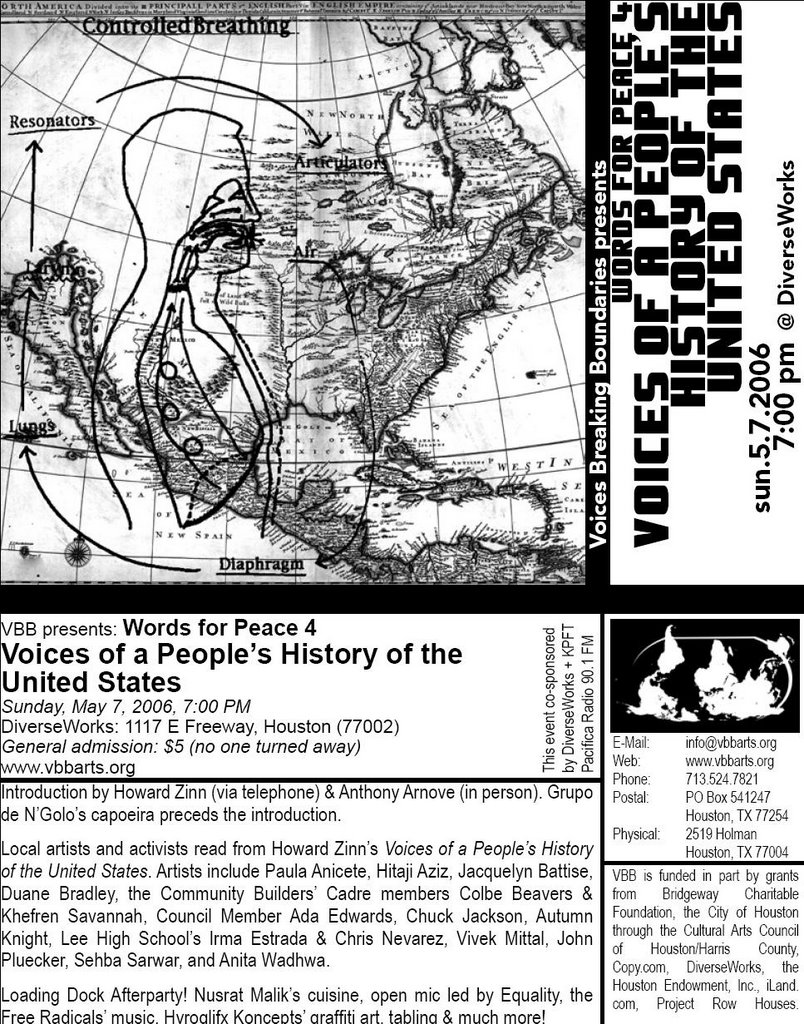
presentsWORDS FOR PEACE 4 ¡Voices of a People’s History!
Sunday, May 7, 2006, 7:00pmDiverseWorks, 1117 East Freeway, Houston, TX 77002
Admission $5 (no one will be turned away)
For reservations, call 713.524.7821, or email
info@vbbarts.org
More info:
www.vbbarts.org

Intros by Howard Zinn (via telephone) and Anthony Arnove, editor of Terrorism and War (in person)·

Featuring local artists/ activists rendering a dramatic version of Howard Zinn’s Voices of a People’s History. Artists include: Paula Anicete, Hitaji Aziz, Duane Bradley, City Council Member Ada Edwards, Chuck Jackson, Autumn Knight, Vivek Mittal, John Pluecker, Sehba Sarwar, Anita Wadhwa, students from Lee High School and Community Builders Cadre·

Open mic and poetry led by Equality, graffiti art by Hyroglifx Koncepts, capoeira by Grupo de N'Golo, music by Free Radicals, refreshments by Nusrat Malik, drinks and much more.

WORDS FOR PEACE 4 ¡Voices of a People’s History! is cosponsored by DiverseWorks and KPFT Pacifica Radio 90.1 FM.

Secret Garden

Can't keep the prisoners from gardening, damnit!

Guantanamo Bay prisoners plant seeds of hope in secret garden
By Andrew Buncombe


With their bare hands and the most basic of tools, prisoners at Guantanamo Bay have fashioned a secret garden where they have grown plants from seeds recovered from their meals. For some of the detainees - held without charge for more than four years and who the US say are now cleared for release - the garden apparently offers a diversion from the monotony and injustice of their imprisonment.

Read more
here.

Coming Back

The event at iFest went really well. Thanks to everybody who came out! This is a copy of the piece I read:

I’m coming back—I remember—as the plane comes in from the East Coast, the air is transparent, I can see the bayous, the wetlands, the coastal marshes leading out into the Gulf of Mexico, then Anahuac and the San Jacinto monument near Baytown. Then hitting the refineries, the plumes of white smoke so high and so dense they obscure the view from the airplanes window, looking ahead of me into Downtown Houston, a dense smog of chemical byproducts and looking back, clarity.

Getting off the airplane, walking out of the terminal and the thickness of the dirty, gasoline scented air envelops my body, crushing it a little, revenge, flooding the lungs with hot, heavy moisture. I gasp for breath, and know that this can be a home.

I moved back to Houston in 2001, to the city I was born but not where I grew up. I moved into a cramped one bedroom apartment in my dad’s old neighborhood, in the East End. The first day, I set up an altar in the corner of the main room.

I put everything on the altar, a rickety cobblers bench from my grandma: candy-raver bracelets from my teenage days, Arabic tea glasses from an ex-boyfriend, a small ceramic flute shaped like a bird, ANC flags, pictures of me in drag...

But mostly the altar was home to random relics of my family: my paternal grandfather’s decommissioned police badges and a rifle he used to go hunting. Pictures of Telephone Road, of the signs from the 50’s for the Jimmy Menutis Club. A photo of an old family ranch in Lockhart in Central Texas clipped from a 1950s newspaper; the headline reads “Mystery Farm.” A photo of my maternal great-grandmother in Mexico on vacation. A stocky, thick woman, she wears thick glasses, sensible black heels, a black skirt with matching jacket, a black hat with a tousle of black tulle hanging off her hat on her back. An indigenous woman half her height looks on in seeming disbelief at this white woman all in black, she wears a dress that reaches the dirt road they are walking on, a serape covers her head, an apron draped across her front . Mountains loom in the background.

It’s all a mystery. I can’t look away from these things, they’re proof to me of my conflicted place in the world.

My mother always says, “Remember who you are,” probably the one comment that really identifies her class, well-to-do white Southerners who doggedly pass their status and their privilege on to their children. Of course, my mother doesn’t mean this when she says it. She means, don’t get into trouble, don’t be mean to people or let them be mean to you.

When I moved back to the East End, I said, look, I not only want to remember who I am, I want to discover this place anew.

***

I took down my altar in 2003 when I realized the past had become present, altars are built for the dead, not for something alive in my life. All the objects covered with dust, grime and dirt. A dark untouched, untouchable corner. One day, in a bittersweet emotional flood, I threw everything into boxes and stowed them away in a storage closet.

Now, the past is present, the present is past is future always. Living in a house a few blocks from the bungalow my grandparents built in the 1920s and my parents sold in the seventies. In the taqueria on the corner, Por Mis Cazuelas, where we buy our morning tacos. In Candé’s hair salon where my cut hair falls on the floor, the same floor my father swept when it was the New System Laundry. Riding bikes down the abandoned railline, now a hike and bike path, small houses abut to the trail, backyard clotheslines, barbecues, old ladies sitting in chairs watching the pedestrian traffic. These same houses where my dad’s family first settled when they arrived to Houston in a duplex in Magnolia on Avenue H. Walking with my boyfriend in the park under the Lockwood bridge over Buffalo Bayou, at the very place where it starts to widen into the Ship Channel. Laying on the newly placed blocks of sod and playing with a lone ladybug in the Spring before the heat hits. The park is built on ground that used to be a Taxi Station that my police officer grandfather patrolled in the thirties.

But I can’t be too wildly nostalgic. The privilege and status is born from oppression, wrought out of a bloody history.

The past rears its ugly head every day. When students walk out and a city condemns them for their foolishness, instead of celebrating their involvement. When a mentally ill man is killed by the police and no real changes result and the killings continue. Yesterday was the anniversary of the battle of San Jacinto, of Texas independence from Mexico, anti-immigrant protestors commemorated the event with signs reading, Texas is not a Mexican Colony. The past lives on. The streets are still maintained wildly better than River Oaks, the Bush family dynasty’s retirement community. Traveling down perfect streets in River Oaks, palm trees, Christmas lights twinkling yearround. But in every community meeting across the city, the complaints pour out. Back in the hood, back in the barrio, there are open ditches, sewage backs up, the sidewalks jut and expand as trees push them up. Kids walk in the street to get to school and get hit.

I have a vision here, somewhere between the beauties of our present moment and the raw injustice of the conflicts rooted in this city, the city itself a product of a blood-stained, broken history.

Somewhere in there—a way to recognize. I have no special claim to this place, I don’t want to be in the center. The view from the margins, the bedraggled outsider watching the palaces, the skyscrapers. What Houston has given me is a sense of place, a sense of root. But staying stuck in geneology and legacies defeats the purpose.

Walk out. The kids had it right. Walk Out. One of these days, we’ll just walk out and keep on walking. And it’ll be one hot sweaty August (or April) day, the kind that soaks you in sweat and in wetness, the sun beating down, and we’ll walk out, scurrying to catch patches of shade where it’s a little bit cooler...

Houston iFest Lit Stage


I spent most of the day at the Houston International Festival Literary Stage where some writing friends and I will be reading tomorrow afternoon...5pm on Sunday...with music from New Orleans musicans, David and Roselyn. The stage is chock full of some amazing writers, from Ishle Park (pic on the right) to Chris Abani and Lolita Hernandez. I stayed out there as long as I could take the heat. If you are in Houston and read this blog, you should go. There is a full calendar for the Literary Stage here.

The Anti-Orientalist

There is a wonderful story on Juan Goytisolo in the New York Times today...


Considered by many to be Spain's greatest living writer, Goytisolo is in some ways an anachronistic figure in today's cultural landscape. His ideas can seem deeply unfashionable. For him, writing is a political act, and it is the West, not the Islamic world, that is waging a crusade. He is a homosexual who finds gay identity politics unappealing and who lived for 40 years with a French woman he considers his only love. "I don't like ghettos," he informed me. "For me, sexuality is something fluid. I am against all we's." The words most commonly used to describe his writing are "transgressive," "subversive," "iconoclastic."

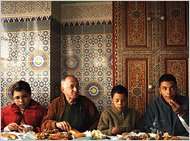
For much of the last 25 years, Goytisolo has lived in a kind of Paul Bowlesian exile in an old house in Marrakesh's medina. In Morocco, he has been able to indulge his passion for Muslim culture — a passion that includes a scholarly interest in Sufi theology, the finer points of Arabic and Turkish grammar and a self-confessed predilection for working-class Arab men.

Read more
here...

Don’t Punish Youth for Speaking Out

My friend Nancy Ambriz and I wrote this Op-Ed for the Houston Chronicle on Wednesday, March 29 after the student walkouts in Houston and across the country. They didn't publish it, so it might as well be here for all to read... JP

Miriam is a 17 year old student at North Shore Senior High School in East Houston. Her mother carried her across the Rio Grande when she was four years old. She has been active for several years in different community groups, fighting so that when she finishes her studies she will be able to work even though she has no Social Security number. Miriam walked out of school on Tuesday in protest of HR 4437, James Sensenbrenner’s bill, which would make her and her family into instant felons.

For years, students in Houston have been too scared to take actions like this, fearful for themselves and for their families and friends. But now, after last Saturday’s march of half a million people in Los Angeles and others across the country calling for earned legalization, students see that they can speak out too. In Houston last Saturday, there was a march sponsored by a group of young immigrant rights activists, in support of the DREAM Act which would provide a path to citizenship for successful high school and college students. The thousands of youth that turned out for this march are the informed leaders in their schools and communities. This week many of their classmates walked out with them.

The walkouts around the country, while often unorganized and impulsive, are the understandable product of a country that has left young people, especially young Latinos, out of the debate.

For years, many students in Houston and across the country have been working on the frontlines on immigration issues, because they affect them on such a personal level. Undocumented students like Miriam can study, work hard in school, strive to succeed and in the end, they will not be able to get a job because they do not have papers. Immigrant families are split on different sides of the border. Many have seen their own relatives deported or living in fear.

Surely all the young people that walked out of their schools cannot articulate perfectly the goals of their actions. But each and every one is drawing from their own personal experience. In the heat of the moment, it’s difficult for anyone to express all the reasons and the historical context for their actions. The walkouts are a visceral, emotional response to years of suffering and bottled up frustration. They carry the flags of their (or their parents’) countries of origin as a reaction to a society that tells them they do not exist. They carry American flags with hope for the future.

Their opinions might not be perfectly expressed or developed, but their frustration is clear.

In Washington and in most of the country, laws (like Sensenbrenner’s HR 4437) are made as if these young people did not even exist.

Despite their good intentions, a backlash is already building against the students. Naysayers on local television stations and in the blogosphere have labeled the students ignorant and uninformed. The response from area police departments and school districts has been arrests in the streets and citations for curfew violations. As was shown on all the local Houston television stations, students have been handcuffed, chased, and harassed. In their schools, they have been threatened with punishment and often put on lock-down.

Just last week, Houston City Council Members debated expanding the curfew on young people. One Council Member wisely asked for students to be involved and consulted before a decision was made. When those young people speak, surely they will ask for the curfew law to be changed to allow for peaceful protest. The schools have to deal with students leaving class on a case by case basis, but, under no conditions, should it be illegal for students to protest. They should not be arrested for expressing themselves, reacting to a society that would criminalize them or their families and friends for their very existence in this country.

Some commentators, including right-wing local politicians, have said that the kids just wanted to leave school. All across the metropolitan area, students left school on a rainy, cold day in order to make their voices heard. They took to the streets with bravado and with little pre-organization.

We would be wise to remember that young people have been at the forefront of all the historical movements for social change in our country, from the African American civil rights movement to the Chicano movement. Often, the opening stages are messy, emotional and loud. This one is no different. While, at this time, there is not a high degree of organization, the energy and the spirit for change are obvious.

We should recognize this week’s walkouts as reactions to a society that excludes young people, especially Latinos and the undocumented, and support them in their actions, not criminalize them in the very moment when they are finding their voices. The conventional wisdom is that since young people and the undocumented do not vote, therefore they are not important. Hopefully, these walkouts and marches will change that perception; these are voices our nation must hear.

Miriam will graduate from high school this year. She has not been to Mexico since she was four years old. She is home already. And, right now, we would do well to listen to her, instead of punishing her.

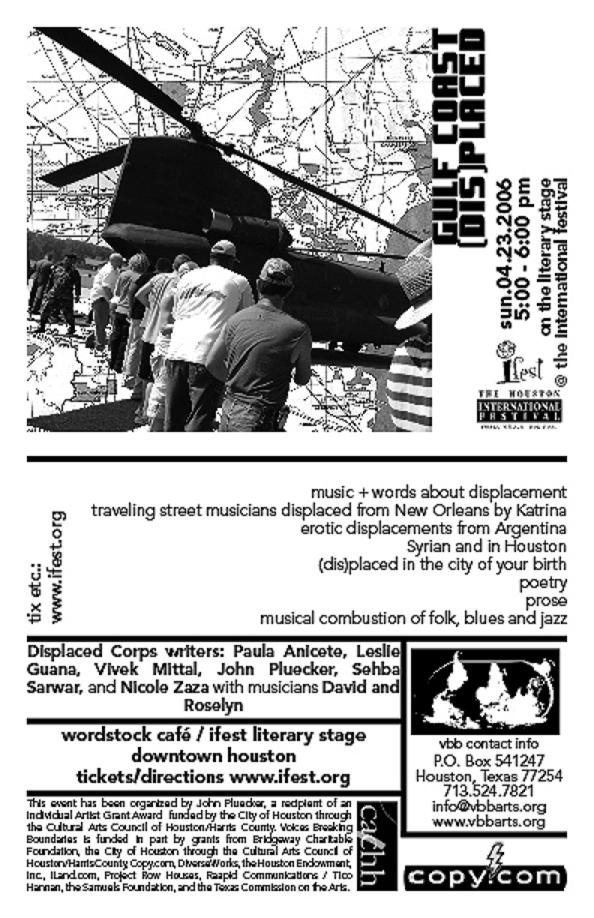
Gulf Coast (Dis)Placed

Come out this sunday to I-Fest (the Houston International Festival) downtown Houston at 5pm! There will be an hourlong show with music and six readers (including me), called Gulf Coast: (Dis)Placed.

Post-Rubén Talk

I just went to see Rubén Martínez give a talk on the American West. It was, de alguna manera, what I want to do. Or am doing. To take a place and know it, to go deep into and learn about it, to interview and talk to people. To see where they are at and what they are doing.

His methodology impressed me. To spend time with people, with the individuals who will form the base of your story, to get to know them and their specificity. To ask them questions, to locate them and to have a stake in their speaking. To make their specificity scream.

To know your history is to know your own specificity.

Telephone Road

Telephone Road, starting with images: the beginning in Eastwood, the historic neighborhood largely gentrified but still with its ragged edges, the forest that used to be where Foley’s and the City office are now; the Tlaquepaque Market that Julio and Damaris del Carpio are building on Telephone, recreating Guadalajara in the East End; the 1920’s brick bungalow we are thinking of buying that sags in the back from water and clay soils and history; the old men who wander at the Family Dollar and Jack in the Box drinking beers in paper bags; doing laundry at the washateria at Jefferson; the peluquería in the old building on the corner where my father used to work at the dry-cleaners in the 50’s; Tex-Mex restaurants with cheese enchiladas with chili gravy for $7.50 next to Por Mis Cazuelas where tacos de queso guisado y nopales go for $1; the train tracks and the low moan of the train late at night as it crosses through the barrio; the old signs along Telephone Road that harken back to another time; the house my grandparents built and the Catholic Church my grandmother labored at for as long as she lived; the 50’s and 60’s my dad told me about, the era that Steve Earle’s song talks about:

Everybody's rockin' out on Telephone Road
Telephone Road is ten miles long
Fifty car lots and a hundred honky-tonks
Jukebox blastin' and the beer bottles ring
Jimmy banging on a pinball machine


My dad raced around these car lots, those honky-tonks. They were his territory, a secret territory that he won’t speak about anymore. “It was a different time,” he says. But if he gets a few drinks in him and we are one-on-one, the stories come out, the things he would rather not talk about openly. Racing Corvettes, getting into trouble with cops, struggling to make ends meet as the man in the house. Things he’d rather forget. But things that I piece back together living in the same stretch of road.

A few years ago, my car was having a hard time passing inspections and I explored some of these car lots on Telephone with a friend, Carlos, an insane formerly-Baptist, former Mexican Youth Revolutionary, who has celebrated his fiftieth birthday every year for at least the last ten years. Since my broke-down car needed bodywork and taillights and a long list of other repairs, I couldn’t take it just anywhere. I had to find one the crooked way. Carlos said he would take me out to try and find a sticker. We searched around parking lots near Hobby Airport, but finally, we ended up at a car lot, Sinclair’s, where an old Chilean friend of his fixed up cars. They scraped off an inspection sticker from another car (not an easy process) and popped it on my car. It sort of looked right. It worked for a while till a young guy at the Jiffy Lube hooked me up with a better looking sticker for an eighty dollar service fee.

As far as the jukebox and the beer bottles, the closest I have come was with a group of pals who all of us together formed a Scary Adventure Club. One of the club members lived on the southern stretches of Telephone south of the Loop. Right in front of her house was one of many Korean owned lounges that line that part of the Road, this one called the Maccalita Lounge. One night, being drunk and high and with more courage than normal, we wandered into the place and bought beers. We were the only customers for a while, no jukebox and no sawdust or beer bottles on the floor. We stayed for a few hours, as the Korean ladies that worked there attended to the lone strangers who wandered into the place. Many middle aged Latino and white men, they would go deep into the bowels of the place and sit down on one of the many slumping, ancient couches that lined the walls and were jumbled randomly throughout. We heard noises, saw bouncing heads, and then the men would leave as soon as they were finished. Not exactly a honky-tonk.

Telephone Road today isn’t the same kind of place it used to be. On the far reaches of Telephone out by the Beltway is an old antiques and flew market that has been transformed into La Pulga – overpriced illegal Mexican cheese, churros, miles of stuff set up in the back of pick-up trucks, on small tables with umbrellas and tarps to cover when it rains. The traffic, mainly pick-up trucks and SUV’s backs up for miles waiting to enter the parking area. The place teems with people wandering around the rows and rows of stalls both in the old antique/flea market section that is indoors and outside where the place explodes in every direction, selling everything from compact discs, DVD’s, clothes, toys, tools, bikes, boots, parakeets, rabbits, washing machines, refrigerators. This ain’t Steve Earle’s Telephone Road.

And yet there is something about how it is today that is not entirely separated from the past, from where the way it used to be. Telephone still has a reputation. A girl at work, Cuban, American, asks me if it’s safe on Telephone Road, if I can walk around after dark. Another girl, a Mexican American, says she wouldn’t ride around in that neighborhood on her bike, especially not after dark or really at any time. Most of my mother’s family, who are old-time West University white folks, have never and would never come to Telephone. It wouldn’t cross their minds and hasn’t for generations. My dad tells me that he proposed to my mother because he was tired of driving that far across the city to pick her up and take her home. It would, he explained logically, be much simpler just to get married. They were hitched three weeks after my father asked for her hand in the sitting room in West U.

Walter Benjamin wrote that of all the existing descriptions of cities, a great minority are actually written by natives of those cities. “The superficial pretext—the exotic and the picturesque—appeals only to the outsider. To depict a city as a native would calls for other, deeper motives—the motives of a person who journeys into the past, rather to foreign parts.” In a city like Houston, there is little time and space for this kind of extended foray into the past, into the city as we live and have lived it. Houston is a modern, forgetful, un-remembering place. A dis-remembering, dismembering place. A city that grew by eating its neighbors, that expanded out like a cancer in Southeast Texas.

But I get lost in Houston, in the history. The Gulf Coast is a thick place – humid air heavy with heat, with moisture, with history. Quoting passages from historical books, the historical record, the official history, I could get lost for ages in the websites, the yellowed pages of the archive, the repertoire of stories, anecdotes and footnotes to a history most often ignored in the everyday life of this low-lying, easily flooded metropolis.

What is it then, to take one street, one road, one neighborhood and enter it, write of it, journey through it, not in the way of an outsider but as one who lives here, but as one who has generations here? For me, the East End has power. Until recently, I thought my family’s connection to the East End was only on my father’s side—the family came from various farming towns in Central and East Texas and settled in First Ward and in Magnolia by the Houston Ship Channel. My father’s grandparents settled there, then moved into the emerging neighborhoods around Telephone; theirs was Broadmoor. But recently, reading a journal written by my great-great-grandmother on my mother’s side, I found out that seven generations back her people lived and died in Harrisburg. Founded before 1826, the town was one of the original Anglo settlements in Texas and in the mid-nineteenth century a rival to be state capital. These generations are still buried somewhere in Harrisburg, although we don’t know exactly where. See, Harrisburg was burned in 1836 by Santa Anna; it staggered back to life despite the fire, but lost ground to Houston. In 1926, Harrisburg was eaten by Houston, becoming part of the East End. More layers of history.

There is so much past on Telephone Road, Harrisburg Boulevard, Macario Garcia, Wayside, the Ship Channel, the parks, the neighborhoods. I want to write these places, these stories. . . but let it be clear that I am not exposing something new, discovering an unknown thing. I am not trying to speak for those who have no voice. I have an imperfect, personal vision, and I only provide a partial take, a walking tour on constantly shifting ground.

A few years ago, Perry Homes put up signs near the train tracks on Telephone that announced a huge townhome and single family home community would be built on an abandoned industrial site. I went with my boyfriend to wander around the remains of the warehouses and out-buildings that were still on the site. We walked into the largest building, sparrows (or were they bats?) alighting in the upper reaches of the shell of a structure. We screamed and listened to the echoes. We took pictures and documented in our minds and on film what was about to disappear. A year later the Perry Homes signs came down and For Sale signs were erected in their place. The company said the investment was still too risky, but it’s only a matter of time before they come back. There is an urgency to these stories then, a need not to forget, before a larger wave of redevelopment remakes these neighborhoods again.
Dis-remembering

Southeast Texas is an area to get lost in historically. The Gulf Coast is a thick place – humid air heavy with heat, with moisture, with history. Quoting passages from historical books, the historical record, the official history, I could get lost for ages in the websites, the yellowed pages of the archive, the repertoire of stories, anecdotes and footnotes to a history most often ignored in the everyday life of this low-lying, easily flooded metropolis.

We are not a place that remembers its history. Instead, a site of reinvention, a place of perpetual recreation and dis-remembering.

My own history is testament to this. But how to talk about personal history in a way that doesn’t devolve into mere nostalgia, into a yearning for a recovering of the past, into a search for truth and for what-really-happened-there.

When I first came back in 2001 to Houston, I wanted to make a movie, to make documentaries. One about other young people who had roots in these parts that went back seven generations. I interviewed friends that met these qualifications. I interviewed my grandmother, my great-aunt. I culled for stories everywhere I could find them. I did find stories, lots of them, but they have become unmanageable, unorganizable and I find that they stay in my brain much easier then they emerge onto paper.

I guess this is part of the reason why I suddenly (very suddenly) think a blog would be a good idea. Because it forces me to put on paper (or on computer) what otherwise would stay in my head and not find a way to escape. I also have tried to publish on these topics, I’ve done some articles in different magazines, sent a lot of query letters and such, but in the end, not much has come of it. I put my email at the end of my articles, my essays, my short stories, and I have yet to really hear from anyone else out there who is thinking about Houston, about history in Southeast Texas, but even more than that, the story of all of us, of our hearts, of this place, this dirt, this ground, this concrete, these buildings, these places that we bury and destroy without much thought.

In 2001, when I first came back to H-Town, there still was a movie theatre at the corner of Wheeler and Main Street. One night, I stopped took out my video camera and filmed the exterior of the place from different angles, it was nighttime and I had noticed caution tape had gone up around the building as if to prepare it for its eventual demise. These images I put into my camera were reminders to me of what had been there of what we could have done with that space. After the old theatre was destroyed, all that was left was a concrete slab foundation in one corner of an entire city block leveled. There is a little grass sliver where the City of Houston has erected a sign that denotes that this small stretch of grass is actually a park. The park will be maintained and the grass fed as a new city, new buildings grow up around it.

Of Montreal, Good Times

Let's pretend we don't exist...let's pretend we're in Antartica. - Of Montreal

Had a great time last night at the show at #'s. Typically, don't like or enjoy #'s so much but this time living large, enjoying the band and the good-natured, dancing crowd. Very few annoying boys to spoil the fun. And no inch-deep pools of fetid urine and shitty water in the boys room, now that's a real improvement from last time when I went home and immediately threw my pants into the washer so as not to have to wake up to the reeking bottom half of the jeans.

The pretending we don't exist is as close as I get these days to Metaphysics or any awareness of myself or ourselves outside of time and space. So much of my thinking is narrative, historical, infinitely placed and specific (I have quite a bit of fear of decontextualizing and losing touch) that last night a rush of joy and pleasure and letting-go swept over me, the thrill of being gone of not being or perhaps of just being in the moment and jerking my legs and upper body about in a hyper-conscious kind of way. I felt that not existing was a viable option and it made me smile.

Let's pretend we don't exist...let's pretend we're in Houston.

It's not as if we are the center of the universe and quite often disappearing from the surface, going underground, being less visible is entrancing and very possible. And seductive, very seductive.

Bad Texas

I suppose a blog can be a test, a way of reaching out to the world or not, as the case may be. I read Cristina Rivera Garza's, Gwen Zepeda's, Anita's, Georgina's. I've been reading them for a while. Pues, me lanzo supongo y a ver como me sale. Pues, sí, orale.