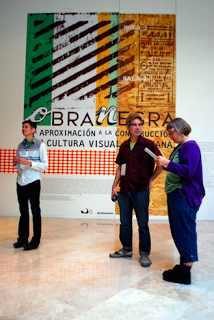
A veces :


: la celebración enmascara la corrupción mejor que la denigración :


: y la decadencia llega a ser otra manera de facilitar la impunidad.


If you're around UC San Diego this
Thursday, May 5, 2011
7:00 - 9:00 p.m.
Literature Building, Room 155 (de Certeau)
Followed by a Reception in Room 138 (Lettau)

More info here.

A Report from the Front

In this case the front is last night's So Much I Want to Say: An Evening of Performances with Future Plan and Program Authors curated by Steffani Jemison at the Houston Museum of African American Culture. Future Plan and Program is a publishing project featuring book-length literary works by visual artists of color. Shockingly strong work. In this case these are words appropriated from said performances as a means of reviewing, participating, collecting, archiving, remembering, saying. Appropriation makes exchange out of property, maybe. In the best of cases. In the worst of cases, the property is just taken, stolen, removed.

(As an extension of that point, I feel a bit strange, uncomfortable posting these copied notes from the performances. I am guessing most of the artists have Google Alarms on your names and will stumble on this eventually. I copied down words from each of your pieces during the performances. In the process of copying, I surely made mistakes and desired those mistakes and I definitely added some new words and made different pieces than the ones you performed. I see this as a way of being in dialogue, exchange. It is a process based on taking though, so knowing taking has a history, all feedback is welcome and will be responded to.)


1.

Aaaaaaaaaaaaaaaaaaaah! Aaaaaaaaaaaaaaaaaaaaaaah!

Writers's block. The circumvolutions of stopped minds. You get the idea.


2.

All the dead voices
make noise like feathers.
If you can't transcend, you might as well descend.You can start from anything.
The silence clamors in my ears.
Let's confront each other.
Impossible.
What if we gave thanks for our mercies.
Where did all the corpses come from?
These skeletons?
Words fail. Is that not so that even words fail at times?
I am not a historian.
We embraced.We were happy.
Let's just keep going. The things you put into your head are there forever.
However much we resist, we're barely contained.


3.


(I/this feeling of awkward/us)


4.

Don't worry about what others are doing. We are all doing the same thing in a different sequence.


5.

Spiritual warrior or one who is warlike. This is not a real name. To become a freer name in the process. On the other hand, a title explains. We've reached a point where the images aren't enough⎯a title appears. The typeface is feminine⎯strong and confident in the middle of the frame.

(We have no way of getting to things anymore.)

In case you ever find yourself asking what the right thing is.

(Different is MLK without his voice. When his words become a title.)

Malcolm X thinks there are plenty of good people in America. Consider the today of the past. He is no longer a boy leaving the hood. The writing on the wall. They're not representative⎯they're instructive. I suggest giving up. Make yourself vulnerable. Be moved by the spirit of the show. Open yourself up to the opportunity of being used.


6.

that looks like me
1959
in the middle who
plugs
down
locked up line.
my siblings.
a baby a desert a wizard to
fit in the weather
he was raped.

(Pay attention to the tap dance. Or don't. Slideshows are the epitome of boringness.)

a common reaction that you have to do
you stamp your feet
this is cutthroat
i tell him "pancreatic ducts"
the tap dance,
more steps.

blue bonnets and a black man in a blonde wig.
until you're tired.
of the tap dance.

(Play with boringness.)

Out of the David Bowie the den.


Sources

1. From the performance of Two Poems By Michael "Truth" Graham & Khorey "Greatness" Smith
2. From the performance of Better then Than When Life Was Babble? By Harold Mende
(Acted by Autumn Knight and Michael Kahlil Taylor)
3. From the performance of The Discussant By Jina Valentine
4. From the performance of So Much I Want To Say By Ayanna Jolivet McCloud
5. From the performance of The Didactic Possibilities of Film Titles By Martine Syms
6. From the performance of Adventures in Babysitting By Jibade-Khalil Huffman

The tragedy, proclaimed, as they made their way up the crescent of the drive, no less by the gaping potholes in it than by the tall exotic plants, livid and crepuscular through his dark glasses, perishing on every hand of unnecessary thirst, staggering, it almost appeared, against one another, yet struggling like dying voluptuaries in a vision to maintain some final attitude of potency, or of a collective desolate fecundity, the Consul thought distantly, seemed to be reviewed and interpreted by a person walking at his side suffering for him and saying: "Regard: see how strange, how sad, familiar things may be. Touch this tree, once your friend: alas, that that which you have known in the blood should ever seem so strange!

- Reading Under the Volcano by Malcolm Lowry on a plane to Houston while tuning out the aggressive conversations of two men in the window and aisle seats fighting over the model sitting in the middle, while perched on a curb at the corner of Taft and Clay, while leaning back in a car with the windows down under a Montrose oak, watching a bird struggling to pick up a twig twice its size and fly off to somewhere safer than the middle of the street. Touch this tree! Alas that that which you have known in the blood should ever seem so strange!

Thankfully, Jen Hofer is writing on the Internet. Quite a bit. Which from what I can tell did not really happen previously so much. Or at least not in as a direct blog-like format. So you can read her marvels at FuturePoem as she discurses on Alan Gilbert's new book Late in the Antenna Fields and declares a set of instructions for suggested art work:

5. Instructions: Narrative tucks information in.

Arrange the books on the shelf according to gradations of color.

Every day for at least seven days, make a poem, paragraph, painting, performance, sculpture, stitched piece, instruction piece, or dessert, taking inspiration from a suite of three books from the same color-field.

Send documentation of the results to chris@futurepoem.com.

Or, respected reader, you can think her thoughts with her at jacket2. A blog of sorts. A journal of trans positions: in transit: in transition: in translation: in motion: in the between:

I can't think about or through poetic language outside the context of the denial of human rights and the silencing of dissent -- in fact, I'm not sure I can think of anything outside that context. And yet what captivates me in the video of the march demanding the return of Carlos René Román Salazar alive is less the language of the demands (though that too is compelling) and more the edges of the buildings against the sky, the backdrop of mountains, the expressions on the faces of people unaware they are being captured on video, the uneven rhythm of many bodies moving not in unison, the kids who whistle and gesture at the camera, the light mobile against the colored surfaces of walls. That is: it's the poetry that captures my attention -- not exclusively, but also not separate from the more immediately instrumental demands of the marchers.

Keep up with Jen on the Internet. Just try. Craig Santos Perez is also on jacket2. Check the flyness. Fly with that check. I resolve to read the New York Times less and jacket2 much much more.

On Generosity

Been thinking a lot about practical ways to build literary community. How to make literary work and life engaging and fun and meaningful and not endlessly ambitious or ego-driven. Barbara Jane Reyes gives some great advice on the Harriet blog about generosity and literary activism. Here's her advice in a shortened form:

1) Don't be shy or reticent about putting your ideas out there. We’re schooled (formally or informally) in poetry and poetics, so we should be able to articulate our thoughts on specific works and movements. So how about this: write articles, papers, essays, interviews, reviews of books written by members of your many and expanding community/ies. Seek publication for these (what good are they, sitting in your hard drive?).

2) Publicize and attend literary events that are not your own, encourage others to as well. Write about these events (not what you wore to the event, not what you ate before the event), and post videos and/or photos from these events on your blog, FB, on Flickr and YouTube.

3) Curate and host events that do not feature you. Feature folks other than your friends. Give emerging writers the opportunity to read alongside established ones.

4) Edit publications featuring writers who are not you, and instead, actively go after those whose works interest and/or challenge you. Again, take a chance and include emerging writers, and feature them alongside established ones.

5) Lead/conduct/teach local, affordable community writing workshops.


I want to do all of these things more and more and more. I found similar advice from another poet, Hoa Nguyen in an interview on Bookslut:

I think it would have helped [when I was young and starting out] to hear that poetry is about engagement, not fame, not recognition. That it is most often defined by how you engage with the conversation of poetry with your contemporaries -- and with the dead -- and to do so from a position of generosity.

Today I am scared. And enraged. 145 bodies have now been found in San Fernando, Tamaulipas in mass graves.

All reports indicate people are being taken off buses between Matamoros and the rest of Tamaulipas by drug cartel members, slaughtered and thrown into mass graves. Hundreds of suitcases are stranded in Matamoros, the belongings of people who didn't make it to their destinations. The worst thing is that none of the bus companies even reported the kidnappings and assaults on their buses. Perhaps unsurprisingly, some reports are saying police officers themselves were partially responsible. Now bus companies are canceling routes. My guess is some companies were covering it up and also distrustful of local authorities and their power to resolve the crimes.

I've seen the "Bienvenidos a San Fernando" sign on many, many occasions. I've personally driven this route or taken buses on this road countless times riding between Houston and Tampico. In fact, buses leave every day to travel this route from my neighborhood in the East End. I don't think I will ever be able to look at this welcome sign in San Fernando again without cringing. I love the land though in this part of the Gulf Coast: flat and full of scrub brush. In the distance, low mountains. An unpretentious, human-sized landscape. And the fact that I and my loved ones have spent so much time on these roads means the violence hits home. It could have been me or a friend or a loved one in those mass graves. But something tells me if it was me with my white skin and U.S. national privileges, there would have been a lot more reporting on my disappearance. The media wouldn't have waited until bodies were found to begin their reporting.

Today, I'm angry and scared and deeply saddened by this news. I just needed to say something in the face of this continuing, daily violence. Even if my words are entirely insufficient to deal with the complexity and horror of this violence.

Last night I went to see artist Ken Gonzales-Day talk at the UC San Diego Art Gallery about his Erased Lynching project. He spoke about his research into the lynchings of Mexican-Americans and other ethnic groups in the Southwest, in California, Texas and along the border. He was able to document hundreds of lynchings and other findings in the book, Lynchings in the West 1830-1935. His artistic project consists of erasing images of lynched bodies but leaving the trees, the audience, the public, the land. The images are haunting and troubling, forcing the viewer to see in an entirely different way, aware of the erasure at the heart of the photo. Gonzales-Day said he didn't want to show to the bodies of lynched people because he wasn't interested either in re-victimizing them or in being known as an artist who exploited images of suffering. Rather, his goal was to make them present in their absence, critiquing the erasure of lynchings in the history of the Southwest.

After listening to him last night and now reading about the San Fernando mass graves, I go back to similar questions. What bodies do we see? Images of the dead in the previous San Fernando mass graves holding 72 Central and South American bodies flooded the media a few months ago. The images of the alleged Zeta perpetrators of the more recent killings are now being circulated.

I have to ask: Which images and bodies are erased? Which are remembered? What do we really see? What do we lose track of? What memories are held in the landscape? What bodies are under the ground beneath our feet, unremembered?

Long Live the Black Minutes!

The Black Minutes has made the Longlist for the 2011 Independent Booksellers Choice Awards.

“We had a last minute rush of votes and it got pretty exciting,” explained Melville House publisher Dennis Johnson. “It was so close that we wound up extending the list to 36 titles from 29 different independent presses.” Johnson said votes came in from many of the country’s most prestigious bookstores, including St. Marks Book Shop and Word in New York, 57th Street Books in Chicago, City Lights and Green Apple Books in San Francisco, Elliott Bay Book Company in Seattle, and Book Soup and Skylight Books in Los Angeles.

Read more here.

(A suggestion: Might be a good idea to mention the translators of books on the Longlist. Just sayin'.)

All of my written life in 355.9 MB.


Sometimes my own smallness scares me.

Turista Libre Goes to the CECUT

In the last year and a half I've spent in Tijuana, I haven't said very much about the city or about the political situation here. There never seems to be a shortage of people willing to expound at length about the city: its strange cultural mix, its violence and its sharp contradictions of First and Third World clashing in one locale. Inevitably all the clichés come out: from postmodern laboratory to den of vice, from beautiful Baja (the happiest place on Earth) to scary TJ (the most violent place on Earth next to Juárez).

In the last year though, I've watched Turista Libre and its tours of Tijuana, lead by Tijuana resident gringo Derrick Chinn. By its own definition, it's a "series of atypical international day tours in Tijuana, Mexico, a caravan that trounces around the city in search of the overlooked and underrated." The mission is simple: "To get foreigners into Tijuana but away from Revolucion. To introduce them the side of the city their local counterparts live on a daily basis. To live for a day as a local in a city that was built for tourists." Definitely an interesting project and one worth watching.

Last weekend, Turista Libre organized a tour of the Centro Cultural de Tijuana (CECUT) and its new exhibition, Obra Negra. I wasn't sure how to respond to this decision prior to the tour, but I've spent some time thinking about it and now I have some ideas.

I thought I'd share some information for everyone who went on the Turista Libre tour or is thinking of going to check out the CECUT: I think everyone should be aware that many Tijuana artists have observed a boycott of the CECUT for almost the last two years. Leading artists and human rights activists originally called for the boycott for a number of reasons. The current director of the CECUT, Virgilio Muñoz, was previously arrested for accepting bribes from human smugglers when he was the head of the Institute of Migration in Tijuana. As human rights activists have noted, Muñoz was never tried on these charges due to a web of connections that allowed him to escape scot free. When faced with demands to step down as director last year, Muñoz lashed out at his critics, calling them "more students than artists" and insulting them as inhabitants of "small worlds" while saying that he moved in larger worlds. Perhaps most unfortunately, there has been no response to the demands of the people calling for Muñoz's resignation, no dialogue, no open discussion and little media attention to the issue. In other words, no democratic process at all.

Recently, a number of artists have also criticized the way the Obra Negra exhibition was organized and curated as it does not include the entirety of the artistic communities of Tijuana, since a large number of Tijuana artists are currently boycotting the CECUT. In addition, a number of artists' names have been used to promote the exhibit after having made explicit requests not to be included in the exhibit.

Unfortunately, these issues have not been well-reported by the
media either in Tijuana or in San Diego. I wonder if any of this was discussed on Turista Libre's tour. I hope someone brought it up and I hope there was some discussion of these issues. In my opinion, if we, as gringos, are going to come to Tijuana and involve ourselves with its communities, we have a responsibility to inform ourselves of the complex situation on the ground here, as difficult or contested as it may be.

(All photos are from the Turista Libre Facebook page.)


My review of the new Norton Anthology of Latino Literature is on-line at the Literal reviews blog:

The new Norton Anthology of Latino Literature has already unleashed and will undoubtably continue to provoke signigicant debate, brow-beating, anger, emotion, territorial defense, criticism, passionate displays of righteousness, tears, boredom, gossip, scrutiny, love and enlightenment (among other things). This process of upheaval is positive. A Norton anthology has a certain weight to it, both physical (2,600+ onion-skin pages in this case) and intellectual (as a tool of canon-formation). While there have been other solid, rigorous anthologies of U.S. Latino literature by respected critics, Norton anthologies have always held a special place in American literary in-fighting, perdón, discussion.

Check out the whole review here.

You never ever, no matter what you accomplish in life, you never become larger than the people who help you to get there.


Un dibujo de Jean Louis Berlandier.

Lo amo.

La leyenda al pie de la foto dice

Eso dice: "Barra del Rio de Panuco con el fortin q hicieron los españoles en 1829"


Como dije, lo amo.


PD Les dedico esta imagen a todos mis queridos que residen en el antiguo Nuevo Santander, especialmente los del puerto más reconocido de la ya inexistente provincia.

TF: Is nonaction an art? A technique? A practice? Maybe it’s simply more of a discipline, in the ethical sense. Can I allow my work to emerge without overinterfering with it, fabricating my ideas about it, growing attached to outcome, the very future of it? Can I let it become what it is, despite the fragments, nonsense, new-sense, noise? It’s simple: don’t force things. Don’t have a Big Idea. In life as well as in writing, can I minimize unnecessary interference, unnecessary aggression? Can I open myself up beyond my own comfort? Can I abide with allowance and impartiality, two disciplines of nonaction?

- Thalia Field, more here.


Really? No one from the Consulate speaks better in Spanish? ¡Por favor!

(Este video, se lo dedico a todos los que me han mandado o que me han platicado de los videos de López Dóriga. La bronca es binacional.)